

As eyes turn to Antalya, the energy and climate crises are piling pressure on governments, and COPs, to show they can deliver on climate pledges. Looking to spaces outside the negotiations, within the Action Agenda, voluntary commitments and vanguard coalitions, can spotlight how fast change can happen. The Clean Energy Transition Partnership (CETP) is a case in point: five years after signing the Glasgow Statement, our members have cut their international public finance for fossil fuels by up to 80% according to new independent analysis. That is at least $8.5 billion a year no longer flowing to overseas oil, gas and coal, despite renewed calls for increased gas financing during the energy crisis. As COPs enter the implementation era, the CETP shows the importance of international public finance as a lever, and why showcasing progress deserves a central place at COP31.
Two publications in the run-up to COP31 demonstrate the significance of the contributions CETP members have made in aligning their international public finance with the goals of the Paris Agreement. In October, IISD and civil society partners published Down But Not Out, their third annual review of the CETP, finding that members’ have cut their international public finance for fossil fuels to near record lows. The authors conclude that this makes the CETP one of the most successful climate leadership coalitions when it comes to implementation. In the same week, Brazil’s COP30 Presidency published the COP30 Presidency Roadmap for Transitioning Away from Fossil Fuels (TAFF) in Energy Systems, framing the transition as much as an economic question as a climate one. Importantly for the CETP, it highlights the alignment of fiscal incentives, public spending, and market signals as a “foundational lever” to address in the years before the 2nd Global Stocktake.
Read together, they show that finance sits at the centre of the TAFF agenda. They also show that the CETP has already proved realignment of public resources is possible within a few years.
What the latest data shows
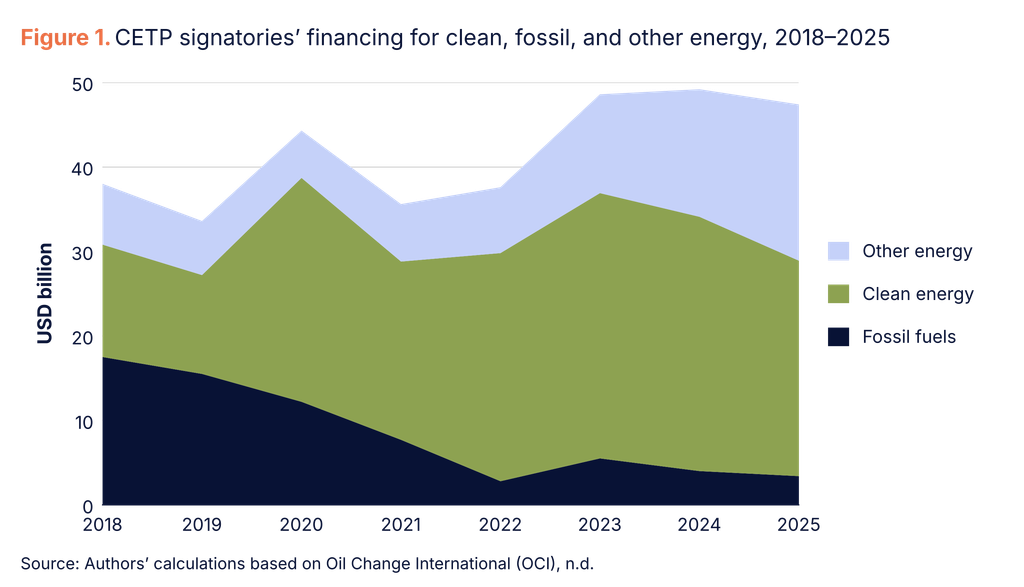
At COP26, CETP members committed to end direct international public finance for unabated fossil fuels and prioritise support for clean energy. Independent tracking by IISD and civil society partners shows they have delivered:
- International public finance for fossil fuels is down 72–80% across members. It fell to USD 3.3 billion in 2025, a cut of USD 8.5–13.2 billion a year against the 2019–2021 average. This progress held through two energy crises and renewed pressure to finance new gas.
- The commitment makes the difference. Non-CETP G20 countries and multilateral development banks (MDBs) cut theirs by up to 63% over the same period.
- Clean energy finance is rising. It is up 28% (USD 5.6 billion) on the pre-CETP baseline. External experts suggest the CETP could make around USD 28 billion a year available for clean energy against its pre-CETP baseline.
- Export credit agencies are part of the solution. Members’ clean energy export support rose 77% between 2018 and 2023, according to Scaling Up Support, Unlocking Investment.
Why international public finance matters for the transition
Despite record growth in clean energy, the financial burden of the transition, both real and perceived, remains the largest barrier countries face. IRENA estimates that meeting the COP28 goals of tripling renewables and doubling energy efficiency needs around USD 5.8–5.9 trillion of investment a year over 2026–2030, including grids and flexibility. That is nearly four times the USD 1.5 trillion invested in 2025. The gap is widest in emerging markets and developing economies (EMDEs), where most future emissions growth is projected.
Public finance for fossil fuels makes that gap harder to close. It risks stranded assets, spends scarce public money on the problem rather than the solution, and sends the wrong long-term signal to private markets, which will provide most of the investment needed.
Ending that support is therefore a necessary early step. It frees fiscal space to manage the transition, removes distorting signals, and makes room to scale up clean energy finance.
Where the CETP fits in the TAFF ecosystem
The CETP is one of several coalitions now implementing parts of the TAFF agenda. Its contribution is specific: aligning international public finance through development finance institutions, export credit agencies, and members’ voices in broader arenas.
- The COP30 Presidency roadmap. The CETP Secretariat fed into the COP30 Presidency’s consultation. It urged that the roadmap address both scaling up enabling finance and removing remaining fossil fuel support.
- Santa Marta process. In April, 57 countries met for the first global conference on TAFF in Santa Marta, with the CETP invited to participate in its own right in the high-level section following contributions to the consultation process. The second workstream of the conference focuses on changing the financial system, including fossil fuel subsidies and debt constraints. The CETP offers a tested precedent for that work, and IISD calls it a model for this “coalition of doers”.
- Coordination. Santa Marta also set up a coordination group of countries leading initiatives that implement elements of TAFF, to carry momentum to future conferences. The CETP’s track record makes it a natural contributor and will continue to engage and contribute learnings and support where needed in the lead up to the next conference.
- COP31. The Türkiye Presidency is prioritising a target to raise electricity’s share of final energy use to 35% by 2035. Meeting it will need clean energy finance at scale, particularly in EMDEs, which is exactly the shift CETP members are making.
From Antalya to Tuvalu: what comes next
The CETP’s experience points to three priorities for COP31 and the road to the second global TAFF conference, co-hosted by Tuvalu and Ireland in 2027:
- Consider the role of finance and fiscal incentives in national roadmaps. Countries developing TAFF and energy transition roadmaps should include the alignment of their own international public finance, drawing on CETP members’ exclusion policies, and where suitable, join the coalition.
- Match the exit with the entry. Only 42% of the finance removed from fossil fuels has been redirected to clean energy. Members are working to scale this up, and successful learnings should be shared more widely, and connected to broader processes to scale up public and private finance to meet the needs of the transition.
- Continue to highlight implementation and the role of the Action Agenda. COP negotiations move by consensus, and often slowly. The Action Agenda, the coalitions and commitments countries make outside negotiated texts, can move faster and in complementarity. The CETP shows that when these initiatives combine time-bound commitments and adaptations to national contexts, they can deliver real change.